You've Done The Therapy. You've Read The Books. You Still Walk Into The Same Walls.
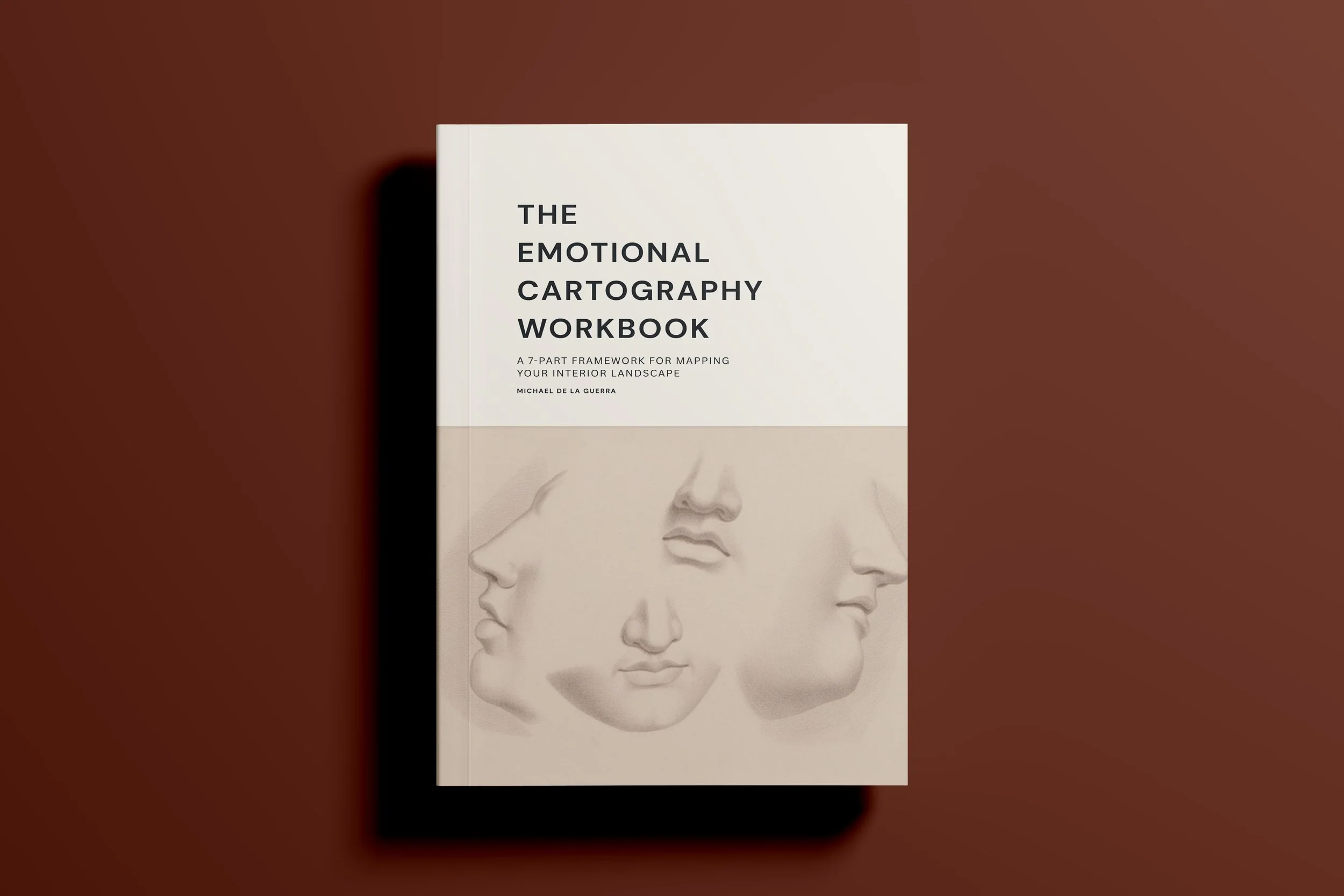
The Emotional Cartography Workbook maps the seven emotional territories keeping you stuck — so you can finally see the pattern instead of just living inside it.





You know your attachment style. You've done the inner child work. You've sat in the therapist's office and named the pattern out loud.
And then you went home and did the thing anyway.
Not because you weren't trying. Not because therapy didn't help. But because knowing what you do and understanding why you actually do it — at the level that changes behavior — are two completely different problems.
Labels don't break patterns. Maps do.
"I have abandonment issues" is a label. It changes nothing.
"I'm 7 years old scared Dad's leaving when my partner doesn't text back" — that's a map coordinate. That's something you can actually work with.

After a year of intensive therapy — $15,000 worth — my therapist had me do something none of the books or apps had asked me to do:
Map it. Not talk about it. Not label it. Map it.
I realized two things. First: this process was the only thing that had actually moved anything in me. Second: it shouldn't cost $200 an hour to access.
The Emotional Cartography Workbook is that process, on paper, in the order that makes it work.
"I created this after my therapist asked me to map my emotional patterns. I realized everyone should have access to this — not just people who can afford therapy."
— Michael de la Guerra, Harvard Business Review case study, currently making art and regretting nothingYou've read the self-help books and felt the inspiration drain out of you within two weeks
You know your patterns — you can see them forming in real time — and watch yourself do them anyway
You've been in therapy and still feel like you're describing the same three things on rotation
The 3 AM thoughts haven't responded to meditation, journaling, or any of the apps
Parts of you keep showing up in relationships, at work, in private — that no amount of "working on yourself" seems to reach
This is not for you if you're looking for affirmations, gratitude prompts, or a reason to feel better about where you are right now. This is for the person ready to see clearly — not feel better.
Each territory is a specific exercise. Each ends with a One-Line Truth — in your own words. Seven territories. One complete map of your interior landscape.
01The Ghost MapQuiet the obsessive thoughts over people you're not supposed to still be thinking about+
Some people live in your head rent-free — an ex, someone who hurt you, someone who never resolved — taking up space that belongs to people actually in your life. This territory traces exactly what you were attached to when you were attached to them. Most people find the answer isn't the person at all. Once you see it, the thought loop loses most of its fuel.
02The Attachment InventoryStop sabotaging your own relationships — and identify the specific move you make every single time+
Not your attachment style. Your actual move — in your own words. "I performed happiness until I couldn't breathe." "I left before he could leave first." "I loved her potential more than her presence." Once that pattern is in your own handwriting, you can catch it in real-time before it's already cost you something.
03The 2:47 AM TruthsLoosen the grip that late-night anxiety and circular thinking have on your brain+
The thought that keeps returning when you can't sleep — you've talked around it, journaled near it, maybe medicated it. It's still there. Anxiety thrives in the vague. This territory forces the thought into a single precise line. Specific things, named exactly, lose most of their power to circle.
04The Beautiful Decay RegistryStop wasting energy trying to fix parts of yourself that aren't actually broken+
Therapy helped. Meditation helped. The books helped. And yet certain parts of you still rear up at the worst moments — in relationships, at work, in private — that don't seem to respond to any of it. This territory asks a different question: what if those parts aren't broken? What if the exhausting project of fixing them is exactly what's keeping them stuck?
05The Childhood EchoesStop overreacting to things you know don't warrant that reaction+
You know the experience: something small happens and your response is completely out of proportion. You can see it happening and still can't stop it. Then you spend a week explaining or apologizing. This territory names the original wound, traces the trigger back to it, and gives you a way to intercept the reaction before it's already out of your mouth.
06The Unspoken Rules CodexIdentify whose rules you've actually been following+
The ones that start with "I should never..." or "People like me don't..." Most of them weren't written by you. Your mother's fear became your law about trust. Your father's absence became your rule about self-reliance. Your first heartbreak became legislation about vulnerability. This territory traces your most limiting belief back to its actual author. Once you know who wrote the rule and why, following it becomes a choice instead of a reflex.
07The Unlived Lives ArchiveStop being quietly haunted by the lives you didn't choose+
There's a version of your life you didn't live. It surfaces at inconvenient times — usually late, usually when something in your current life isn't working. This territory names that alternate self specifically enough to understand what it actually represents. Once you know what it is, you can bring that quality into this life without burning everything down to get there.
Territory 1 will make you uncomfortable. Territory 3 will probably keep you up. Territory 6 might make you cry.
Comfortable healing is usually just spiritual bypassing with better marketing. Plus: pattern recognition guide, integration exercises, and emergency protocols for when the work gets heavy.
The framework that connects all seven territories into a single map.
What to do after you've named something. The work that follows the insight.
For when the work gets heavy. Because sometimes it will.
Every other tool you've tried was built around the assumption that you're broken. This workbook is built around the opposite: you're not broken. You just don't have a map. There's a difference between those two starting points.
IFS, attachment theory, somatic work — useful frameworks. Also someone else's vocabulary applied to your experience. This workbook produces your own vocabulary, in your own handwriting.
There's actual neuroscience behind why therapists insist on handwritten work. You can't ghost a workbook sitting on your nightstand. (We know you have a downloads folder full of PDFs you'll definitely open someday.)
500 copies. Numbered and signed. When they're gone, the next run goes on a waitlist.
"Territory 3 made me realize why I've been having the same fight with my husband for 8 years. We both did the workbook. Everything changed."
"I've spent thousands on therapy. This workbook revealed patterns my therapist and I never found."
"The Ghost Map alone was worth it. Finally understood why I think about certain people constantly but avoid them in real life."
Join the waitlist
First 100 waitlist members receive 30% off, free shipping, and the digital companion guide.

Spent a decade as a copywriter — featured in Harvard Business Review, Wall Street Journal, Fast Company — writing for billionaires and Fortune 500 companies. He walked away from all of it. He works in academia now and spends the rest of his time making art that tells the truth about emotional complexity.
The Emotional Cartography Collection — the poetry-art prints — came from his own therapeutic process. So did this workbook.
"Deep inner work requires honesty and curiosity, not a diagnosis or a degree."